
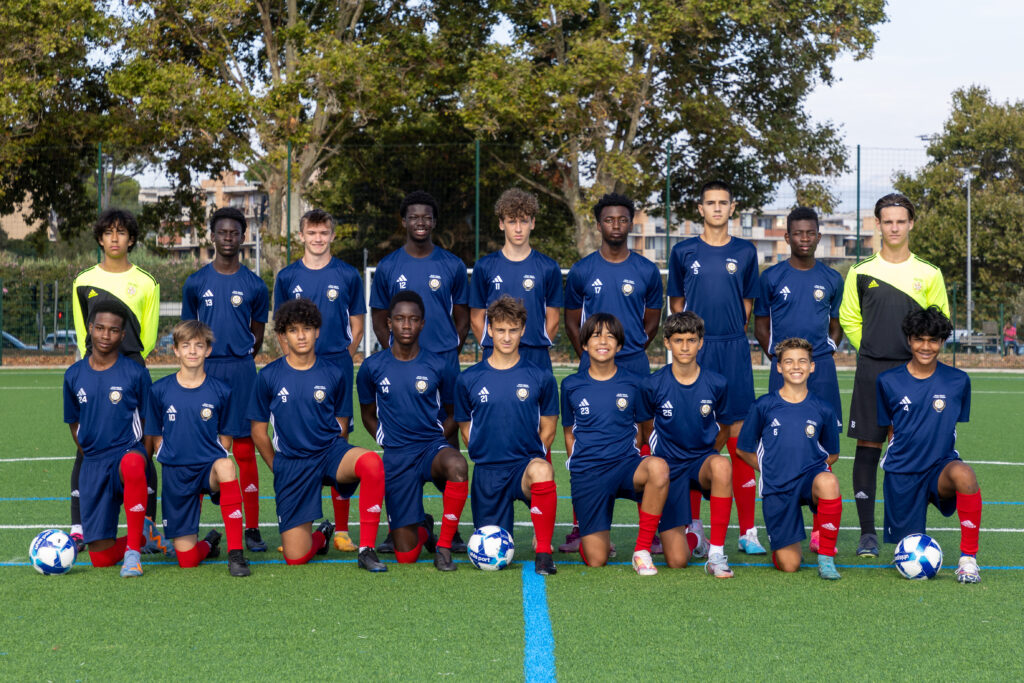


At ages 14, 16, or 18, thousands of young football players and their parents ask themselves the same question: Do they have to choose between football and a high school diploma? The answer is no. But successfully balancing football and academics requires the right structure, a rigorous approach, and strong personal support. That’s exactly what we’re building every season at the Hidalgo Football Academy in Antibes, with young players representing 68 different nationalities.
This guide explores the realities of football and high school: program structures, mistakes to avoid, criteria for choosing a football academy, and practical tips for helping a young athlete grow into a well-rounded adult, ready for elite competition—or for a successful career off the field.
Why the dual football-academic program becomes essential after age 14
Starting at age 14, playing football takes on a whole new dimension. Smaller teams give way to 11-player games, the physical intensity increases, and competition among young players becomes much fiercer. This is also the age when school becomes more demanding: the brevet, the bac, and post-bac planning.
In this context, pursuing a dual path is no longer a luxury—it’s a safety net. Statistically, fewer than 1% of players trained in a French youth academy sign a professional contract. This means that 99% of teenage athletes will need a degree, an academic pathway, or a career change.
The Three Realities That Change Everything During Adolescence
- Training volume often ranges from 4 to 10–15 hours per week, which can be exhausting for an athlete who isn’t properly supervised.
- Physical maturity varies: some hit their stride at 15, others at 19. Patience becomes a strategic skill.
- School-related decisions (academic tracks, exams, Parcoursup) come at a time when training is at its most intense.
A successful balance between school and football , therefore, does not mean “doing less sports” or “spending less time in school.” It means organizing both intelligently, with a coherent schedule and individualized support.
Different ways to balance football and school depending on age
There is no one-size-fits-all approach to balancing sports and academics. The right choice depends on the young athlete’s age, academic level, football skill level, and long-term goals.
Ages 14–16: Building a Structure Without Rushing Things
At this age, the priority is to build a solid foundation in both technical and academic skills. An effective football-and-academics program offers 8 to 12 hours of football training per week, a traditional school curriculum (middle school or high school), and a progressive physical training regimen that takes the player’s growth into account.
Ages 16–18: The Time to Specialize
Here, young football players must compete in official matches, ideally in the French league through FFF-licensed partner clubs. The schedule is similar to that of a semi-professional player: 15 to 20 hours of football per week, plus classes and recovery time.
Ages 18–22: Focus on Academic Achievement or a Bridge Program
At this stage, the dual path becomes a dual career: a professional contract, an American university (NCAA), a bachelor’s degree in sports science, business school, or a return to high-level amateur football. Football training must be combined with a credible Plan B.
Out of every 100 young people trained at a vocational training center in France, fewer than one will sign a professional contract. A well-thought-out dual-track plan isn’t a hindrance—it’s what allows you to keep playing without fear.
How to Choose a Football Academy for Teens in 2026
The market for football academies has become increasingly crowded. Between traditional “sports-and-academics” programs, private international academies, and professional club training centers, it can be hard to know where to start. Here are the criteria that really make a difference.
1. The quality of individual support, not the size of the student body
A serious football academy rejects the “conveyor belt” approach: every teenager has a unique profile. Ask how many players each coach is responsible for, how individual training plans are developed, and whether regular video analysis is part of the program.
2. The Reality of Official Competition
Football training without official matches isn’t enough. Make sure the academy fields its players in league play through FFF-licensed partner clubs. That’s the only way to improve in a real competitive environment and get noticed.
3. Practical Academic Support
Balancing sports and academics requires a flexible yet demanding academic framework: online courses, academic support, flexible scheduling, and exam preparation. An athlete who doesn’t receive adequate academic support will eventually fall behind—both on the field and in the classroom.
4. The human aspect, not just the athletic aspect
A young athlete who leaves his family at age 15 needs a supportive environment: coaching, housing, psychological support, and a sense of community. At the Hidalgo Football Academy, the philosophy is based on three pillars: individual potential, a sense of privilege, and human values.
Balancing Football and School: The Method That Really Works

The theory is simple. Putting it into practice is challenging. Here are the principles we apply in practice with our young players throughout the 10-month immersive program (August through May).
Plan your week in blocks, not by the hour
The brain of an athlete in high school does not handle constant switching well. We group activities into blocks: mornings for academics, afternoons on the field, and evenings for recovery. Exams are scheduled 6 to 8 weeks in advance.
Tailor the training load
A 15-year-old football player going through a growth spurt does not train the same way as a physically mature 19-year-old player. The training load must be continuously adjusted based on simple indicators: sleep, fatigue, and performance on tests.
Using Video as a Teaching Tool
Video analysis isn’t just for pros. For a teenager, reviewing 5 minutes of a game makes it possible to correct tactical details in a matter of days rather than months. It’s a major catalyst for progress.
Develop character as well as technique
A young person’s football training isn’t limited to just playing the game. Resilience, discipline, coping with failure, and communication: these skills last a lifetime, both on and off the field.
Mistakes That Can Derail a Dual Football-Academic Program
Many talented young players fail not because they lack skill, but because of avoidable mistakes. Spotting them early makes all the difference.
- Betting everything on football by dropping out of school: a losing bet 99% of the time.
- Increasing the number of school districts every year: technical and academic instability.
- Neglecting recovery: injuries, chronic fatigue, and a decline in performance.
- Ignoring plans for after high school: the transition to adulthood at age 18 or 19 becomes abrupt.
- Underestimating the importance of family support: Young athletes need a stable emotional environment.
A dual-track approach is built over time. Successful families are those who are willing to think in terms of 3- to 5-year cycles, rather than isolated periods.
The Hidalgo Model: Immersion, Competition, and Human Values

Located in Antibes, between Nice, Cannes, and Monaco, the Hidalgo Football Academy offers a 10-month immersive program designed for young football players ages 14 to 22. The model is based on three concrete commitments.
A high-intensity football experience
Personalized daily training sessions, official matches in the French league through FFF-licensed partner clubs, video analysis, and individualized strategic development. All of this takes place in an international environment, with players representing 68 different nationalities.
Flexible academic support
Balancing football and school is possible thanks to tailored academic support, flexible schedules, and individualized guidance. Every young athlete maintains an academic path that aligns with their goals.
A Commitment to Human Values
Our belief: no two young players are alike. We reject the “assembly-line” approach. Character, confidence, and resilience are developed just as much as technique. That’s what enables our players to aim for a professional career—or to calmly consider another path.
To get a concrete idea of how a season unfolds, you can review the academy’s complete immersive program and the enrollment requirements.
FAQ — Frequently Asked Questions About Football and High School Studies
Yes, provided there is rigorous organization and appropriate guidance. The dual-track program rests on three pillars: clear weekly planning, individualized training loads, and concrete academic support. Without these three elements, the dual career quickly becomes unbalanced.
Fees vary widely: from a few thousand euros per year for a public school program with special arrangements, to €20,000–40,000 for a private international academy with boarding. Some programs offer athletic scholarships. We recommend comparing not only the price but also the actual content: time on the field, official matches, individualized coaching, and academic support.
Technical skill matters, but it’s not the only criterion. Reputable football academies also evaluate motivation, learning ability, tactical intelligence, team attitude, and resilience. A teenager with average technical skills but a strong work ethic can progress faster than a precocious talent who lacks discipline.
This is the most likely scenario—and it must be anticipated. A well-structured dual track allows students to earn a high school diploma, a college degree, a spot in the U.S. NCAA, or admission to a specialized school. The young athlete leaves the academy with a well-rounded profile: discipline, English proficiency, international experience, and maturity. These are assets sought after far beyond the world of football.
Not necessarily, but international experience offers real benefits: language immersion, exposure to different playing styles, and independence. Organizations like the Hidalgo Football Academy in Antibes welcome players from 68 countries and provide this international environment without leaving Europe.
Ready to pursue a dual track in football and academics?
For teenagers, balancing football and school isn’t a compromise—it’s a strategy. When done right, it allows a young player to excel at the highest level while keeping all options open. When done wrong, it sacrifices both.
If you’re an ambitious teenage athlete or a parent looking for a serious program, the Hidalgo Football Academy offers a 10-month immersive program in Antibes, featuring official competition, video analysis, academic support, and rigorous coaching.
Ready to take your football to the next level? Apply now. Contact us at contact@hidalgo.academy or visit us at 50 Av. 11 Novembre, 06600 Antibes, France. Our team will respond within 48 hours to review your profile and walk you through the next steps in the admissions process.