



Every year, thousands of young players and their parents ask themselves the same question: do they have to choose between football and school? The answer is no. The world’s most successful academies have realised that a solid sporting career is never built at the expense of education, but alongside it. A player who thinks quickly on the pitch is often a player who has learnt to think in the classroom.
This guide is aimed at families looking for a clear path for an ambitious young footballer: understanding the existing pathways, learning how to balance football and school, identifying careers in football beyond the pitch, and asking the right questions before committing. You’ll find practical guidance, common pitfalls to avoid and actionable steps you can take today.
Why education remains a cornerstone of a young footballer’s sporting career
The success rate in reaching the top level is stark: out of a generation of players entering a youth academy, only a minority sign a professional contract. This figure, which is well known to all scouts, makes one thing clear: a sporting career without an academic safety net is a risky gamble. Education is not a Plan B; it is a safety net and a catalyst for maturity.
A young footballer who follows a structured educational programme develops skills that are directly transferable: discipline, time management, the ability to analyse complex instructions, and resilience in the face of failure. These are precisely the qualities that professional clubs look for in players aged between 16 and 20.
- Safety: a qualification remains valid even in the event of injury or non-selection.
- Credibility: international recruiters value well-rounded candidates.
- Career change: careers in football (coach, analyst, fitness coach, agent) often require academic qualifications.
- Mental: the school routine helps the player stay grounded during periods of sporting doubt.
Practical advice: before signing up with any organisation, ask for a written explanation of how the institution organises academic support. A scheme without a clear answer to this question is not a scheme, it is merely a hope.
Existing programmes: football and studies, sport and studies, and football certification
In France and across Europe, there are several schemes that allow pupils to combine sports training with their school education. Knowing about them helps you avoid making a choice by default. Each model has its own strengths and typical profile.
The traditional football-and-studies programme
The ‘football and studies’ scheme involves a partnership between a football club and a school, with a flexible timetable. Players train in the morning or late afternoon and attend lessons during the day. This is the most common format in France, often linked to a school sports programme.
Sports-based education programmes and youth development centres
Sports-and-study programmes accredited by the federation offer enhanced support, including boarding facilities and medical care. They are suitable for players who have already been identified by regional authorities. The selection process is rigorous and the pace is intense.
Football certification and federal qualifications
The term ‘football certification’ refers to professional qualifications related to a career in football, such as the CAP in football-related trades or federal certificates. These pathways are often aimed at players who have completed their training and wish to secure a recognised qualification whilst remaining within the football industry.
International schools with an integrated curriculum

Some private academies, particularly on the Côte d’Azur, offer an immersive programme: intensive training, competition in official leagues and flexible academic support. This is the choice of many international families seeking a serious professional football programme without sacrificing their children’s education.
Key point: the right model isn’t necessarily the most prestigious on paper; it’s the one that matches the player’s actual ability, their maturity and the family’s goals.
One in a hundred players turns professional. All one hundred will need their education. A sporting career is therefore always built on two pillars.
How to balance football and studies on a day-to-day basis: methods that work
In practical terms, balancing football and schoolwork hinges on three key factors: time, energy and support. Here’s what really works for players aged 14 to 22.
Plan your week, not your day
Successful players don’t plan hour by hour: they plan in blocks. Two evenings set aside for lengthy homework sessions, two lighter evenings after training, and a weekend tailored to their matches. This flexibility helps prevent mental exhaustion.
Treating recovery as a subject in its own right
Sleep, nutrition, hydration: these factors influence learning ability. A player who sleeps for 8 hours learns more quickly and recovers better between sessions. Recovery is not time wasted; it is time well spent.
Make the most of downtime
Journeys, waiting times, travelling to competitions: these moments add up to several hours a week. Revision sheets, short reading passages and listening to lesson podcasts turn these spare moments into opportunities for academic progress.
Rely on management that communicates
The decisive factor remains the human element. When coaches and teachers communicate with one another, scheduling conflicts disappear. A young player caught between two worlds that do not communicate with one another will eventually crack. It is vital that the adults around him are on the same page.
Tip: Agree on a simple rule as a family. No single week should include more than two major school assessments and one long journey. If this does happen, you need to find a compromise, not just put up with it.
Careers in football made accessible through education
A career in football is not limited to being a professional player. The industry employs tens of thousands of people across Europe, and most of these roles require a qualification. Here are the main career paths.
- Coach: compulsory national qualifications, often supplemented by a university degree in Sports Science.
- Video and data analyst: candidates with a background in statistics, computer science or sports science.
- Fitness coach: a degree in Sports Science followed by further specialisation.
- Sports physiotherapist: state-recognised qualification, in high demand at sports clubs.
- Sales representative and manager: a background in law or business is strongly recommended.
- Recruiter: practical experience, plus assessment and reporting skills.
A player who does not reach professional level has not failed: they are simply taking on a new role. Careers in football offer long and exciting paths for those who have prepared for the transition. This is precisely why football qualifications and university courses related to sport are becoming increasingly valuable every year.
Choosing a private tuition centre: the criteria that really matter
All private schools present themselves as ‘elite’. To make the right choice, you need to ask specific questions and demand evidence. Here is a checklist used by experienced families.
- Real competition: do the players take part in official league matches? Under what circumstances?
- Academic support: who organises the courses, with which partner institution, and what is the exam pass rate?
- Individual coaching: how many players per coach? Is there a personalised development plan?
- Video analysis: a structured teaching tool or a marketing gimmick?
- Verifiable results: where are the former residents now? Can we contact their families?
- Environment: safety, health, accommodation, distance from amenities.
A reputable project will welcome an audit. An organisation that refuses to provide names, figures or contact details is often hiding a less than favourable reality. Insist on transparency before signing.
The international immersive model: a response to the limitations of the traditional system
For many international families, local provision is not enough: limited competitive opportunities, a lack of personalised support, and language barriers. The immersive model, developed on the Côte d’Azur, offers a different approach.
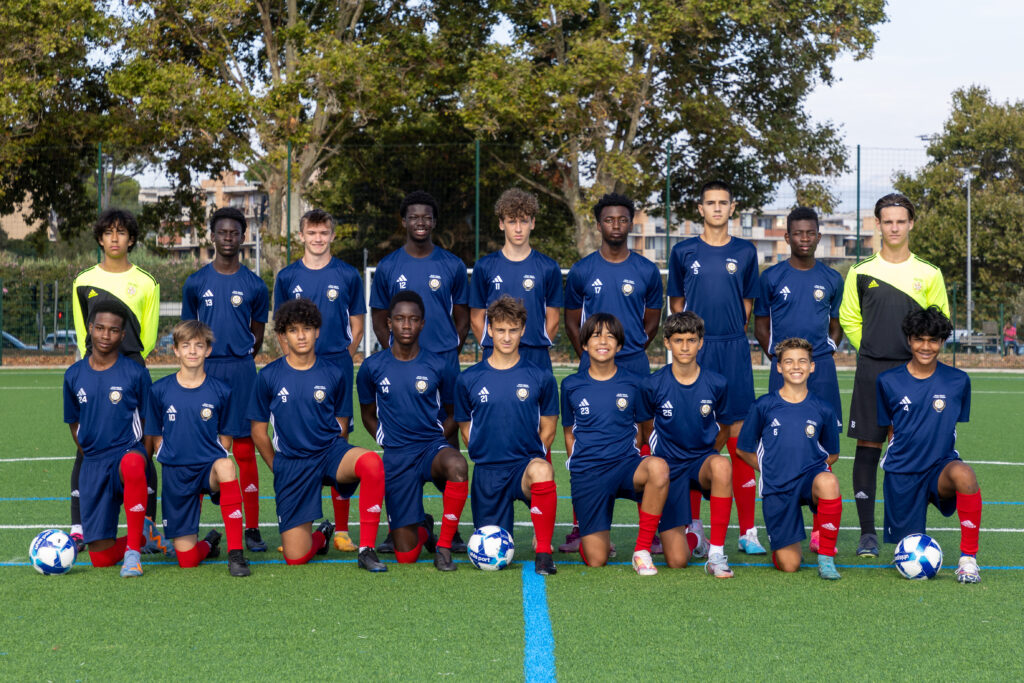
Just like the programmes offered by international academies based in Antibes, players train intensively from August to May, play competitive matches through FFF-licensed partner clubs, and benefit from video analysis and flexible academic support. All this takes place in a multicultural environment that also prepares them for a career as an overseas-based player.
This format is suitable for players aged 14 to 22 who want a professional training regime without having to give up their studies. It does, however, require a high degree of maturity: away from home, players must take ownership of both their sporting career and their education.
For families who are unsure, the rule is simple: visit the academy, watch a session and speak to current players. A day spent there is worth more than ten leaflets. You can also find out about the academy’s full programme to assess whether the format suits your circumstances.
Common mistakes to avoid in a young footballer’s career
After years of working with international players, certain patterns of failure keep cropping up. Identifying them early on can change the course of a player’s career.
- Sacrificing one’s education too early in the name of uncertain ‘potential’.
- Carrying out a multitude of trials without any consistency, to the detriment of steady progress.
- Ignoring mental strain: an exhausted player stops making progress.
- Confusing fame with development: a club that gets a lot of media attention is not always a good training ground.
- Neglecting English, which has become essential for an international career.
- Waiting until you’ve finished secondary school to think about a career change.
Every mistake can be corrected before it happens. The role of parents is not to push, but to provide structure. The player’s role is not to daydream, but to work methodically.
FAQ — Frequently asked questions about a young footballer’s education
Is it really possible to balance football and studies at the highest level?
Yes, provided there is rigorous organisation and coaching staff who communicate effectively. Academies that incorporate flexible academic support achieve better academic results than those that leave players to fend for themselves.
At what age do you have to choose between football and your studies?
Never. The right approach is to keep both options open until a signed professional contract makes an adjustment necessary. Forcing a choice at the age of 14 or 15 closes doors unnecessarily.
What exactly is a football certification?
It is a recognised qualification relating to careers in football, such as the CAP in football-related professions or the federal certificates. These qualifications help to secure a career path within the football industry, even without a career as a player.
Are international academies recognised by the federations?
It depends on the club. The most reputable ones work with licensed partner clubs, which allows players to take part in official league matches. Always check this before signing up.
How much does a football-and-study programme abroad cost?
Prices vary considerably depending on what is included (accommodation, tuition, competitions). Ask for a detailed quote and compare what is actually included. A price quoted without any details is meaningless.
What should I do if my child does not reach the professional standard?
He can remain in football by taking up a role within the sport: coach, analyst, fitness coach, scout or agent. A solid academic background makes this transition a natural one rather than something he is forced into.
Taking action: developing a coherent sports and education programme
A successful young footballer is not the one with the most raw talent, but the one with a clear, structured and well-supported plan. Education does not hinder sporting progress: it makes it sustainable. Families who understand this set their children on a path where every season brings new skills, not just statistics.
The right approach consists of three steps: clarifying the actual sporting objective, choosing a club that meets both requirements, and checking the evidence rather than the promises. This is precisely the philosophy of an academy that rejects a one-size-fits-all approach and draws up an individual plan for each player.
Are you ready to give your child a genuine sporting and academic programme? Apply now or email us at contact@hidalgo.academy. Our team, based in Antibes at 50 Av. 11 Novembre, 06600, supports players from over 68 different countries every year as they progress to the highest level, without ever compromising their future.